
Fredericksburg City Directory Shelf
The earliest known surviving Fredericksburg city directory is Chataigne's Fredericksburg and Falmouth City Directory for 1888-1889. It is available as a photocopy in the Central Rappahannock Regional Library's Virginiana Room and as a digitized UMW resource. Later confirmed local years include 1892, 1910-1911, 1921, 1933, and 1938. The Central Rappahannock Heritage Center reports a broader Fredericksburg directory holding from 1888 through 1991, while the Fredericksburg Regional Genealogical Society guide identifies Historic Fredericksburg Foundation directories from 1965 through 1997, with some gaps. Those are collection endpoints, not a promise that every year survives or is online.
| Directory or companion set | Verified years | Fredericksburg holding | Best access route |
|---|---|---|---|
| Chataigne's Fredericksburg and Falmouth City Directory | 1888-1889 | CRRL Virginiana photocopy; UMW digitized resource | Name, trade, office or home location, and cross-street wording |
| Fredericksburg City Directory | 1892; 1921; 1933; 1938 | UMW, Virtual Virginiana, CRRL cataloging, and Heritage Center holdings | Inspect the title page and the individual volume before citing a publisher |
| Fredericksburg Directory | 1910-1911 | UMW and historic-district references | Pair the entry with 1910 census and Sanborn-map evidence |
| Heritage Center directory shelf | 1888-1991 | Central Rappahannock Heritage Center | Contact staff because the public catalog is only a partial list |
| Later directory supplement | 1965-1997, some gaps | Historic Fredericksburg Foundation, reported by FRGS | Email lookup requests through FRGS when the shelf is not digitized |
The published sources do not establish a complete publisher chronology after the Chataigne volume. A title page or a library catalog entry should settle that question for a specific book. The collection also has useful companions: an 1885 business directory in The Free Lance, local newspapers, maps, tax material, and deed, trust, and will indexes. Together they make the printed volume more than a name list.
Note: A year missing from an online collection may still be on a local shelf, in microfilm, or available through a staff request.
Fredericksburg Directory Cross Streets
The 1888-1889 Fredericksburg volume does not work like a modern address list. Its location phrases use cross streets and landmarks: ab means above, bel means below, nr means near, and cor means corner. RF&PRR is a railroad reference. A household can therefore appear at a phrase such as a street corner rather than at a numbered property. Copy that wording exactly before trying to translate it into a current address.
Older city maps are the bridge. The city's historic maps collection identifies map resources from 1721 through 1916, and the Library of Congress makes an 1886 five-sheet Sanborn map publicly available. Map evidence can reveal the former street pattern, a nearby railroad, building footprints, and a cross street that is absent from a current search. It cannot by itself establish who lived in a building.
Directory language is also historical source context. The original Chataigne volume used an asterisk in a way that reflected its period. Preserve the notation when transcribing it, but do not treat it as a current classification. Check name variants as well, because old indexes preserve spelling rather than normalizing it.
Fredericksburg Directory Research Room
The Virginiana Room at Central Rappahannock Regional Library is on the lower level of the Fredericksburg location. It brings together local books, map cases, vertical files about houses, people, and businesses, microfilm and microfiche readers, and newspapers reaching back to 1788. The library also prepared local newspaper indexes through historian Bob Hodge. A specialist appointment can be requested at virginiana@crrl.org or 540-372-1144 ext. 7239 when a volume, file, or map needs local context.
The library's Virtual Virginiana route links remote researchers to UMW primary-document material. It includes digitized directory volumes, census-derived inhabitant lists, merchant-license lists, tax records, legal-transfer indexes for deeds, trusts, and wills, newspaper indexes, and insurance-policy indexes. Use the online copy for discovery, then check the original or the shelf copy when exact punctuation, a page image, or a title-page detail matters.
The Virginiana Room source page shows the local-history setting behind this Fredericksburg directory research.
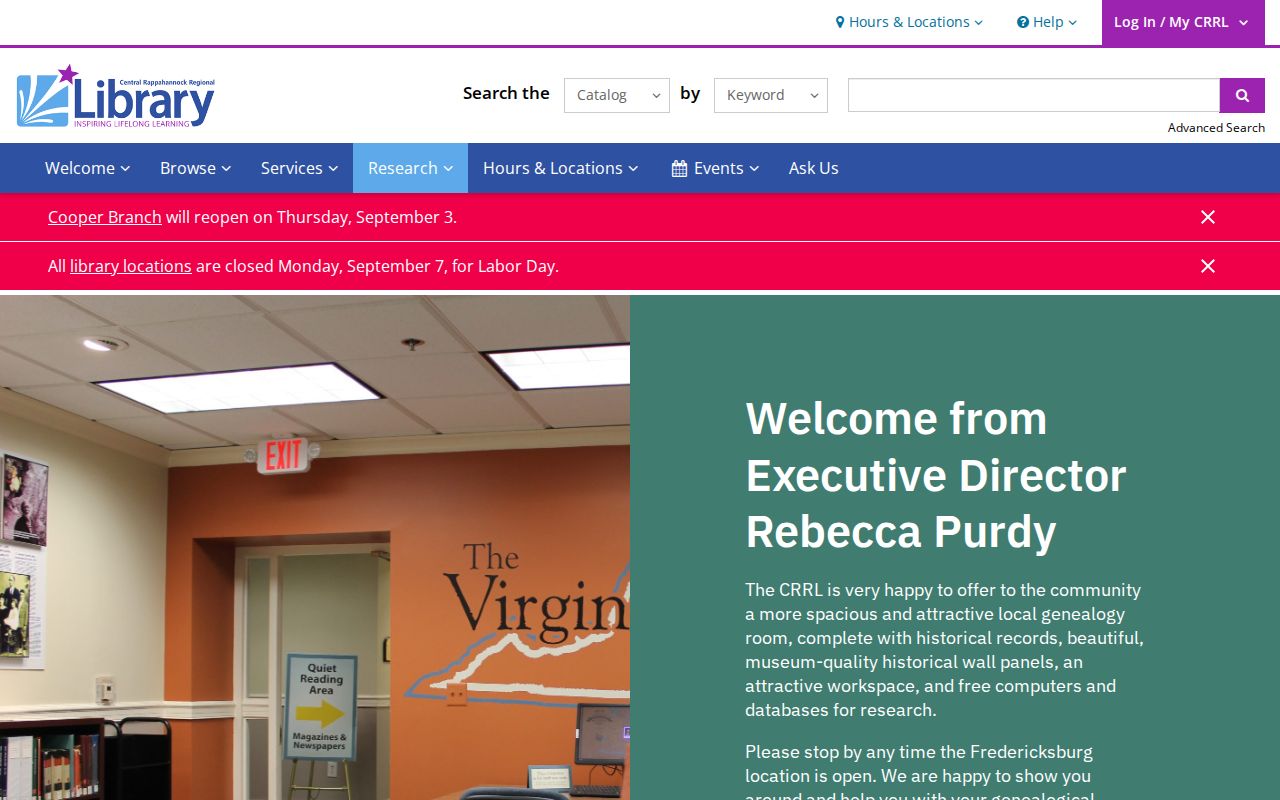
Its microfilm readers, vertical files, and map cases are practical fallbacks when a directory year is not available through the digitized collection.
Fredericksburg Archive Directory Records
The Central Rappahannock Heritage Center adds a deep regional shelf to Fredericksburg directory research. It reports more than 120,000 documents and photographs from the early 1700s forward. Its holdings include directory volumes, deeds, cemeteries, clubs, fraternal records, school material, yearbooks, voter registrations through 1904, maps, plats, railroads, WPA surveys, and Free Lance-Star bound volumes. The newspaper run from January 1933 through December 1969 is especially useful when a directory entry changes between editions.
The Heritage Center is open Wednesday from 1 to 4 and on the second Saturday of the month from 10 to 1 at 900 Barton Street #111. Its PastPerfect catalog is online, but the center describes it as partial and asks researchers to contact staff for a fuller check. The archive accepts service requests and charges a nominal copy fee. Give staff a full name, a rough date range, an organization or address, and the Fredericksburg or county jurisdiction when asking about a folder-level lead.
The Heritage Center collections page documents the local directory range and companion archival material.
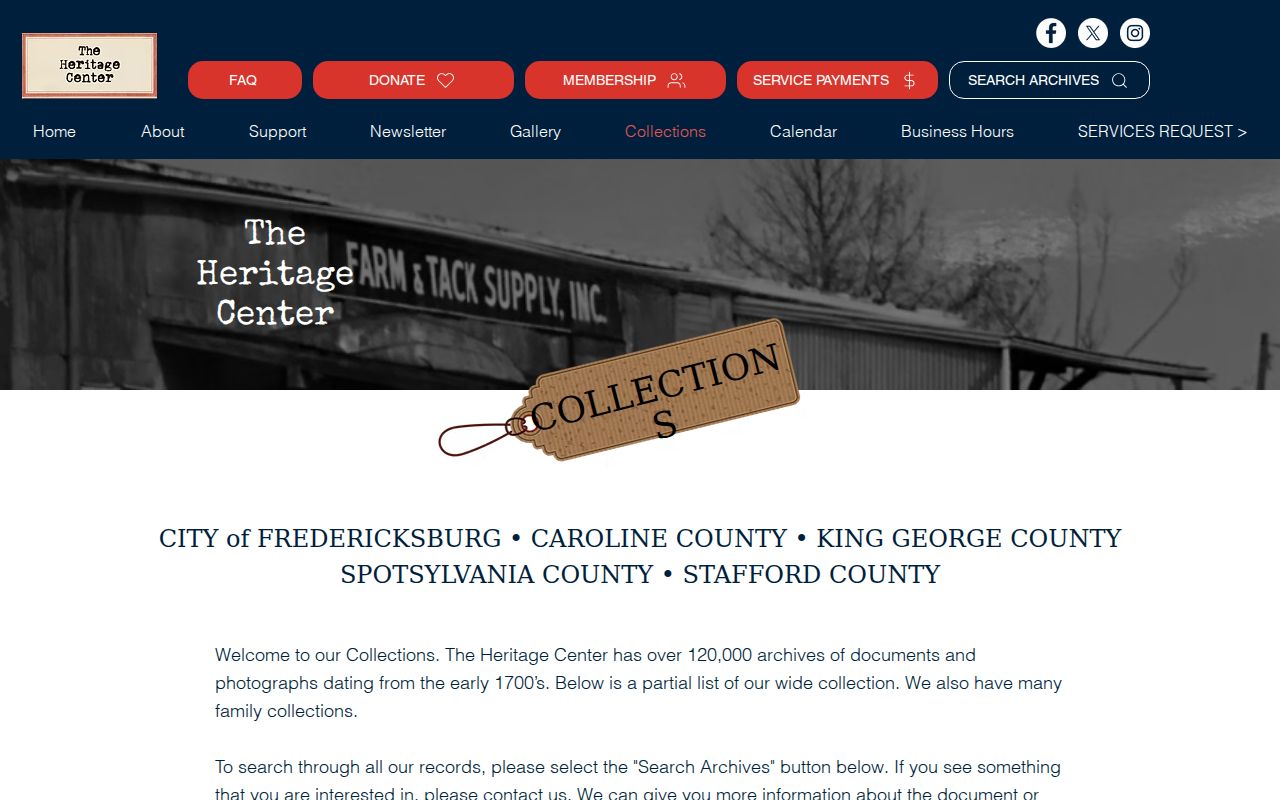
Directory volumes and bound newspapers can be checked together there, which helps distinguish a move, a business change, and a gap in the printed run.
Read a Fredericksburg City Directory Entry
A Fredericksburg directory entry is best read as a compact record inventory. The 1888-1889 transcription exposes surname, first name, stated trade, office address, and home address. Some entries also use a widow reference, such as a person's name followed by the name of a deceased spouse. A business location and home location are separate facts. Neither proves every person connected to the household, and a listing does not replace an original court, vital, or property record.
| Surname and given name | Record the spelling exactly, then try reasonable spelling variants in companion indexes. |
|---|---|
| Stated trade | A period description that can help separate people with the same name. |
| Office location | The listed business or professional location, when supplied. |
| Home location | A numbered address in later material or a cross-street phrase in the early directory. |
| Relationship wording | A widow or estate reference can point to a marriage, death, probate, or newspaper search. |
- Criss-cross directory
- A street-order section in a directory that has one, used to move from an address to listed names. The inspected sources do not confirm which Fredericksburg volumes contain it.
- Householder index
- A name index organized around the listed household head or address. It is an index aid, not proof of everyone at that place.
- Abbreviation key
- The explanatory key, often near the front of a volume, that decodes shortened words and location marks. Photograph or transcribe it before reading entries.
Fredericksburg Archive Record Survival
Fredericksburg's directory shelf sits within an unusually durable local record story. The Circuit Court Archives reports that loose papers and bound volumes survived Civil War destruction. That survival helps explain why early local research can combine directory clues with wills, marriages, inquests, court actions, military papers, apprenticeships, and other historic material. The city describes its Historic Court Records databases as free searchable extracts, while the original records remain the item to verify at the archives.
| 1782-1962 | Local databases include marriage-index material across this span. |
|---|---|
| 1782-1957 | Will extracts provide a companion source for a directory name. |
| 1792-1945 | Inquest extracts can add death evidence and local context. |
| 1888-1889 | The earliest known surviving local directory supplies the first verified directory snapshot. |
The Historic Court Records interface keeps names as found. Its enslaved-person index reports more than 35,252 names and 4,405 unique names, with spelling variants retained. Search broadly, then confirm a promising extract against the original source. For fragile loose papers, the Circuit Court Archives requires an appointment and provides the local fallback when a web extract is incomplete.
Note: Historic extracts are research aids, so an original page, certified record, or custodian confirmation remains necessary for a formal claim.
Trace Families in Fredericksburg City Directories
Begin with the first confirmed appearance of a surname, then move through the next available Fredericksburg volume rather than assuming an unbroken annual run. Copy the entry as printed, including trade, office location, home location, cross-street wording, and any relationship note. Then compare it to the closest census year. The available federal census sequence, including 1900, 1910, 1920, 1930, and 1940, gives a separate household snapshot that can test whether a change in the directory reflects a move, a spelling shift, or a different person.
- Find the surname in the earliest relevant directory and preserve every location phrase exactly.
- Check the next confirmed Fredericksburg directory year for a changed address, trade, widow reference, or business listing.
- Use historic city maps and the 1886 Sanborn sheets to translate a cross-street description before applying a modern street number.
- Pair each directory point with the closest census, then add an obituary, marriage, death, deed, or court record only when it fits the same person and place.
- Use newspaper notices and archive material to explain a disappearance instead of guessing why a name is absent.
A name that vanishes may indicate a move, death, a spelling change, or an omitted listing. It does not settle the question alone. If the need becomes a current address-based check rather than a historical household trail, the Fredericksburg street directory has the separate modern parcel and street-record workflow.
Fredericksburg City Directory Gaps
A printed directory is a snapshot, not identity proof. It may omit a person, use a shortened name, preserve an outdated location, or describe a place before modern street numbering. Boarders, visitors, and other household members can appear inconsistently. A historical label also does not resolve the present-day record jurisdiction. Fredericksburg became an independent city in 1879, and older court geography can overlap with Spotsylvania history. Check the source's date, the locality named in the entry, and the map or legal description before sending a records request to a custodian.
For years not on a digitized path, use the Virginiana Room, Heritage Center, Library of Virginia microfilm catalog, Circuit Court Archives, and city historic-record databases in that order as the evidence requires. CRRL newspapers reach back to 1788, and Virginia Chronicle offers free historical newspaper images with title-by-title coverage that varies. Those channels are more reliable than treating a blank online search as proof that no local record exists.